How Champagne Is Made: From Grape To Bottle
Champagne is not just a wine, it is a two-fermentation process that happens mostly underground. Here is how it works, in the order a cellar tour walks it.
Short answer
Champagne is made by pressing grapes, fermenting the juice into still wine, blending, then triggering a second fermentation inside the bottle with yeast and sugar. The bottles age in chalk cellars, are riddled to collect sediment, disgorged, topped with a dosage, and corked. The appellation covers 34,200 hectares and 319 villages, and shipped 266.1 million bottles in 2025.
Champagne starts as three grapes, mostly chardonnay, pinot noir and pinot meunier, grown across 34,200 hectares in 319 villages, and it ends as a bottle that only becomes fizzy because a winemaker trapped a second fermentation inside it. Everything a visitor sees on a cellar tour in Reims or Epernay, the chalk tunnels, the stacked bottles turned slowly on their heads, the frozen necks waiting to be opened, exists to serve that one trick. Understanding the sequence turns a nice walk underground into a story with a plot.
This guide walks the method in the order a tour usually walks it: the vineyards first, then the press house, the blending bench, the deep cellars, and finally the riddling racks and the disgorgement line. Along the way it covers the 2026 harvest, the region's climate, and which day trips from Paris and Reims actually show you each stage, with prices as the operators list them.
How Is Champagne Actually Made?
Champagne is made in two fermentations. The first turns freshly pressed grape juice into a still, dry, fairly acidic base wine. The winemaker blends that base, adds a measured dose of yeast and sugar, bottles it, and seals it, and the second fermentation inside the sealed bottle produces the carbon dioxide that becomes the bubbles. Everything after that is patience, cold chalk, and skilled housekeeping.
The double fermentation is what legally and technically separates champagne from almost every other sparkling wine. A still wine is fermented once, in tank or barrel, and bottled. Champagne wine is fermented once, blended, then fermented a second time in the very bottle you will eventually open, so the gas has nowhere to escape and dissolves into the wine under pressure. Open the bottle and that dissolved gas releases as foam and fine bubbles.
The region's northern climate makes the whole method possible, and also necessary. Reims-Courcy climate records from Meteo-France show average daily highs of just 24.7 C in July, the warmest month, with rain falling on 114.4 days a year across the station's statistics. Grapes that ripen slowly in a cool climate keep high acidity, which would make poor still table wine but makes an ideal base for a wine that spends years maturing on its lees in a cold cellar.
The scale is bigger than most visitors expect. The appellation counted 16,460 growers and 410 houses in official figures from the Comite Champagne, and 266.1 million bottles were shipped in 2025. Most growers sell their fruit to the houses rather than making wine themselves, which is why a single cellar complex in Reims can stretch for kilometres underground. Moët & Chandon's network alone runs to 28 km beneath Epernay, a figure the house states on its own visit page.
What Happens In The Vineyards Around Reims And Epernay?
The vineyard year runs from winter pruning through bud break in late March and April, flowering in May and June, colour change in August, and harvest from mid-August into September. Growers work the same slopes their grandparents worked, and the 2026 season compressed the whole calendar forward by about two weeks, the earliest start ever recorded in the appellation's history.
Pruning runs from November to March, pausing in mid-December to mid-January when hard frost makes the vines too brittle to cut cleanly. It is the single most important manual job of the year, because it decides how many buds, and therefore how many grape clusters, each vine will carry. Bud break follows in late March and April, a nervous period, because spring frost can wipe out young shoots and the region still averages eight to nine rainy days a month in summer.
Flowering in May and June sets the crop, and veraison in August, when the berries soften and pinot noir and meunier turn from green to black, signals the countdown to picking. The official vineyard calendar from the Comite Champagne places harvest from mid-August to September, stretching into early October only in cool years. In 2026 there was no stretch: the harvest review published on 9 September confirms the first vineyards began picking on 6 August, the ban was announced on 12 August, and picking was widespread from 17 August, about 14 days ahead of 2025 and the earliest on record.
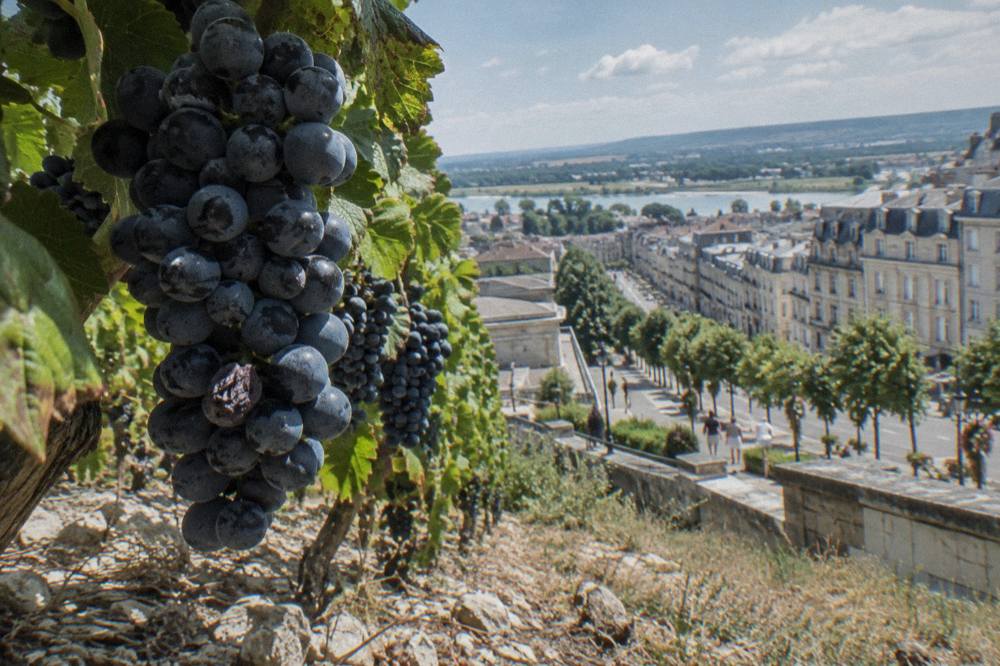
The heat that drove that early start also shrank bunch sizes, which kept yields moderate, and the same review reports fruit in exceptional sanitary condition with the balance the trade body links to legendary vintages. The practical consequence for visitors is that harvest in Champagne is no longer reliably a September spectacle, and a day trip in late August may already cross working vineyards.
| Vineyard Stage | Typical Timing | What It Decides |
|---|---|---|
| Pruning | November to March, paused mid-December to mid-January | Bud count and crop size |
| Bud break | Late March to April | Frost risk window |
| Flowering | May to June | Fruit set |
| Veraison | August | Ripening countdown |
| Harvest | Mid-August to September, early October in cool years | Entire year's crop |
Seeing the vineyards themselves, rather than just the cellars, is the reason to choose a tour that stops in the villages. The E-Bike Vineyard Day, from $213.00 per person, small group capped at 8, rated 4.84 across 232 reviews, rides through Aÿ-Champagne and Hautvillers with lunch included, and it spends its day in the exact rows this calendar describes. From Paris, the 6 Tastings trip from $262.28 per person stops at Abbaye Saint-Pierre d'Hautvillers, the hillside village where the monks first worked these vines.
The nine-tasting day is based in Reims and focuses on a family producer at Rilly-la-Montagne and Roger-Constant Lemaire, which is where pressing and fermentation happen at small scale. The 8 Tastings day from Paris, from $364.00 per person, pairs a major house with a family estate, so you see both the industrial and artisanal ends of the method in one 10-hour run.
What Do You See Inside A Champagne Cellar?
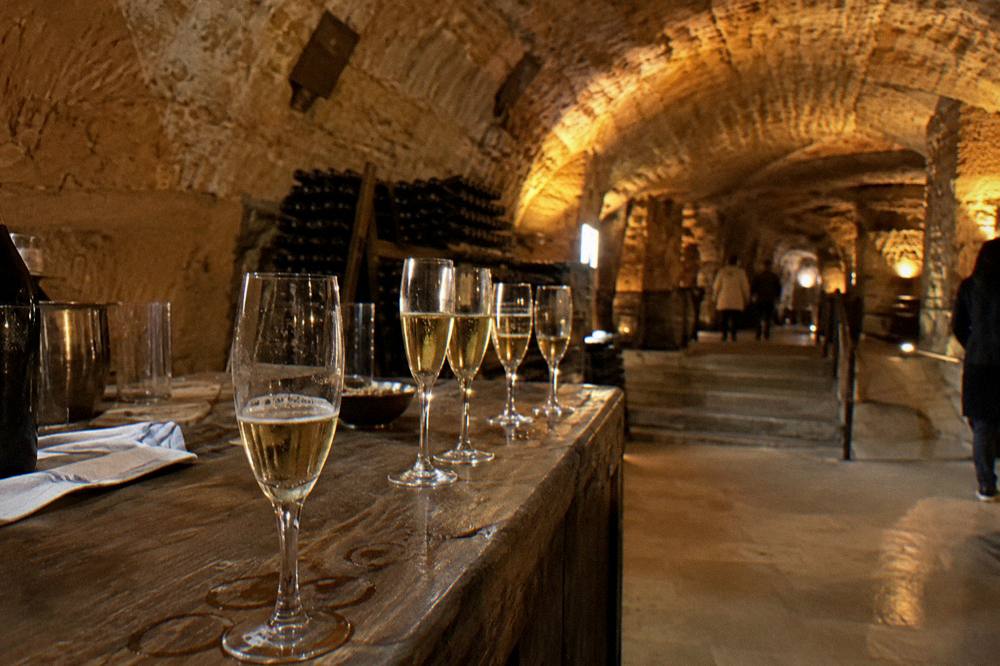
A cellar tour shows the second half of the method: kilometres of chalk tunnels where bottles stack horizontally for years, slowly developing flavour on their spent yeast. In Reims the cellars reach eighteen metres down at Taittinger, run beneath the house itself at Pommery at a steady 10 C, and much of the network is UNESCO-listed as part of the Champagne Hillsides, Houses and Cellars inscription from 2015.
The chalk is the quiet hero of the region. The same soft stone that Roman quarrymen cut for building blocks became, a millennium and a half later, the ideal maturation cellar, because it holds a stable temperature and humidity year round. At Pommery the house states the cellars sit at 10 C in every season, and at Taittinger the visit page describes cellars and Gallo-Roman chalk quarries eighteen metres underground, listed as UNESCO World Heritage. Moët & Chandon tells visitors its cellars are cool and to bring warm clothing, and its network spans 28 km beneath Epernay.
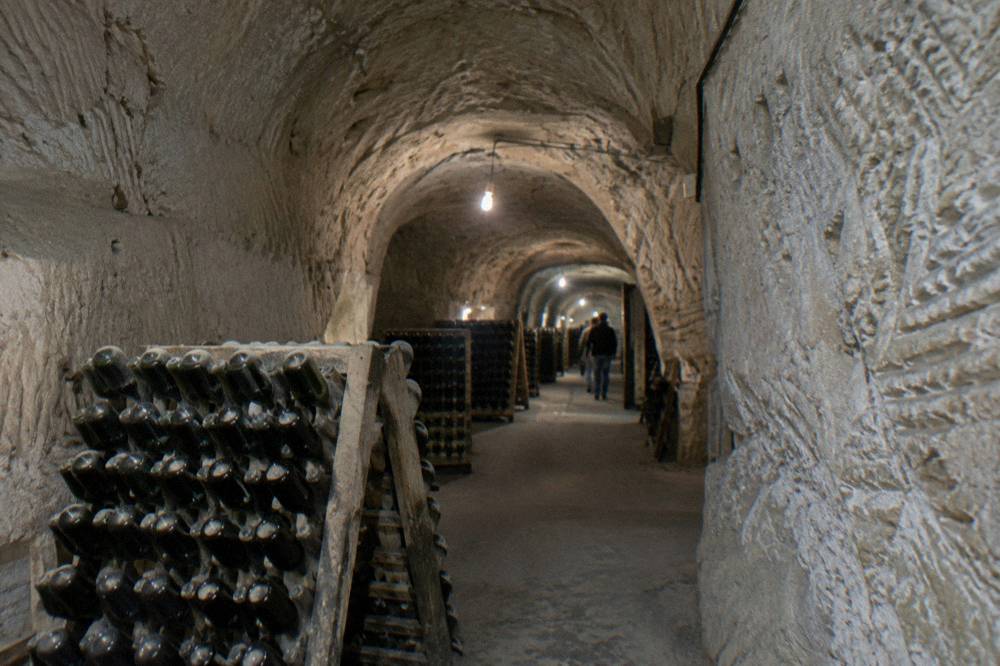
What the bottles are doing down there is the second fermentation and its long aftermath. Once the wine, the added yeast and the sugar are sealed in, fermentation produces alcohol and carbon dioxide, and when the yeast runs out of sugar it dies and settles as sediment, the lees. The wine then sits on those lees for years, picking up the brioche, toasted-nut complexity champagne is famous for. Guides on house tours walk you past racks and racks of exactly this: wine quietly becoming champagne.
This is the stage where booking a guided tour pays off most, because the tunnels are not self-explanatory. The Sommelier Guide day from Paris, from $291.00 per person, small group capped at 7 and rated 4.94 across 143 reviews, includes Pressoria Champagne Museum at Aÿ, where the sensory exhibits explain pressing and fermentation, before continuing to Avenue de Champagne and Moët & Chandon.
For visitors planning the visit around the houses themselves, the only house prices quoted here; see each booking page. Moët & Chandon lists its entry cellar tour at 48 EUR and its Signature tour at 65 EUR, each lasting about an hour and a half, and Veuve Clicquot lists its Brut Yellow Label tour at 36 EUR. For every other house, including Mumm, Taittinger, Mercier and Nicolas Feuillatte, no reliable public price exists, so check the house's own booking page before assuming anything.
| House | City | What The Official Pages State |
|---|---|---|
| Moët & Chandon | Epernay | Entry tour 48 EUR, Signature 65 EUR, each about 1 hr 30 min, 28 km network |
| Veuve Clicquot | Reims | Brut Yellow Label tour 36 EUR, cellars include UNESCO-listed crayères |
| Pommery | Reims | Cellars at 10 C year round, TGV from Paris about 45 minutes |
| Taittinger | Reims | Cellars 18 m underground in Gallo-Roman quarries, UNESCO listed |
Why Does Champagne Need Time On Its Lees?
After the second fermentation the bottles rest horizontally in the cellars on their dead yeast cells, the lees, and that contact is where much of champagne's flavour and texture is built. The sediment slowly breaks down and releases compounds that give the wine its brioche, pastry and nut notes, while the cold, stable chalk keeps the process gradual. Time is not optional, it is the ingredient.
A young bottle straight through second fermentation tastes sharp, thin and aggressively fizzy. The same wine after years on the lees in a cold tunnel rounds out, gains aromatic depth, and carries a finer, more persistent bead, because the dissolved gas integrates as the wine ages. House guides make this point constantly, usually while standing in front of bottle stacks labelled by year, because it explains why the tunnels you are walking through are full rather than empty.
The rules that govern the appellation, set by the Comite Champagne, define minimum ageing in bottle before release, and the best houses age well beyond those minimums for their top cuvées. The exact numbers vary by category and are the winemaker's territory, but the principle is fixed: vintage and prestige bottles disappear into the chalk for many more years than a standard non-vintage blend. That is why the underground cellars of Reims and Epernay are counted among the UNESCO-listed Champagne Hillsides, Houses and Cellars, and why a visit feels like walking through a library of vintages, a storehouse of wine in slow motion.
The method also explains a quirk visitors often notice: champagne is blended wine. The winemaker combines still base wines from different villages, grape varieties and harvest years to build a consistent house style, then the second fermentation and lees ageing unify the blend. Only in exceptional years does a house declare a vintage and bottle the single year alone, which is why 2026's outstanding fruit quality, described in the official harvest review in terms the trade reserves for historic vintages, matters so much to what will surface from these cellars a decade from now.
What Is Riddling And Disgorgement?
Riddling is the slow turning and tilting of each bottle so the yeast sediment slides into the neck, traditionally by hand over weeks in angled racks, today mostly by machine. Disgorgement then freezes that sediment plug in the bottle neck and ejects it under pressure, the wine is topped up with the dosage, and the bottle is corked and wired. These two steps finish the wine and set its sweetness.
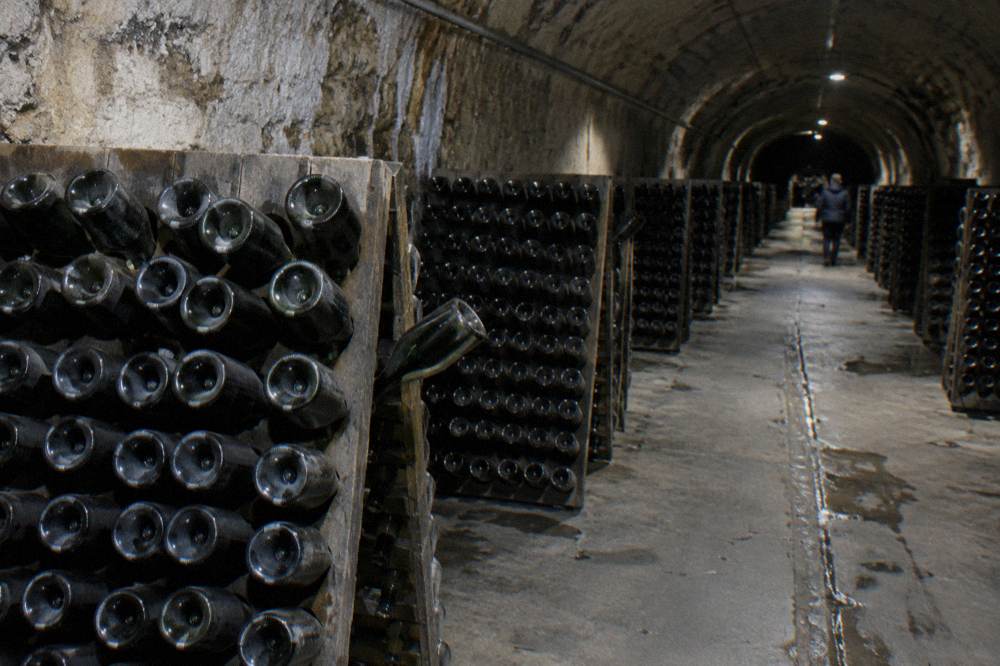
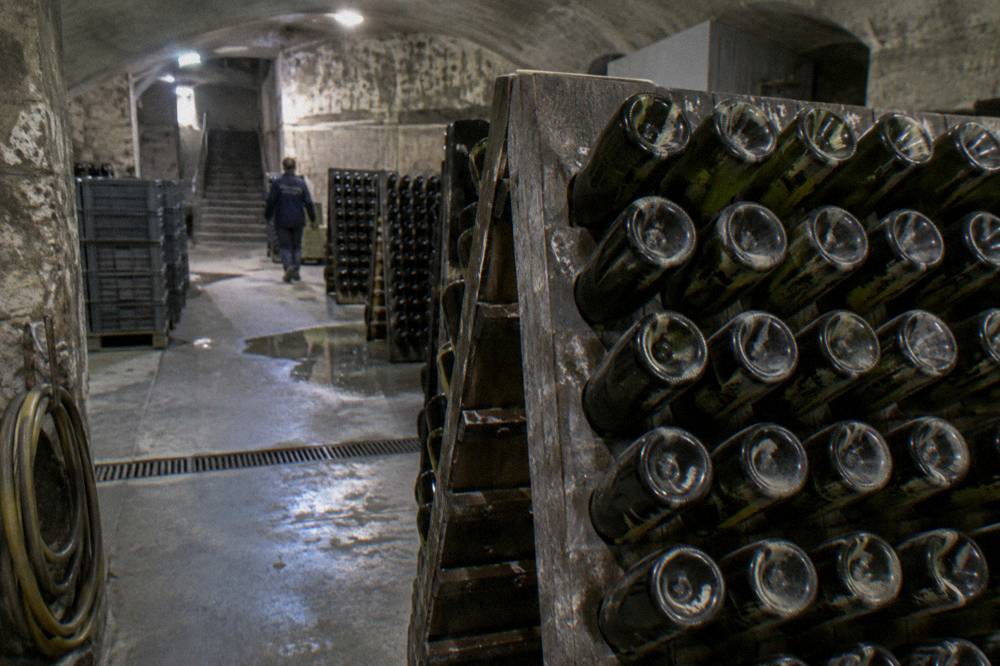
Riddling racks, the wooden A-frames with holes punched at an angle, are the most photographed object in every cellar for good reason: they are where craft is visible. A remueur working by hand turns each bottle a fraction each day, gradually shifting it from horizontal to near vertical, so gravity walks the sediment down the shoulder into the neck against the cap. Machines called gyropalettes do the same job in days rather than weeks, and most high-volume production now passes through them, though many prestige cuvées are still riddled by hand.
Disgorgement is the dramatic half. The bottle neck is dipped into a freezing brine, the plug of sediment ice forms, and when the cap comes off the internal pressure pushes the frozen plug out cleanly, losing only a splash of wine. The winemaker then adds the liqueur d'expédition, the dosage, a small measure of wine and cane sugar whose sweetness level decides whether the bottle is labelled Brut, Extra Brut or something drier or sweeter, and the final cork goes in with its wire cage.
Timing matters too. Disgorging late, after long lees ageing, keeps more of the aged complexity, while disgorging and shipping young keeps the wine fresher and fruitier. Some grower-producers print the disgorgement date on the back label, and on small-family visits around Reims and Epernay the host will often tell you the date for the bottle in your hand. That level of detail is exactly what separates a grower cellar visit from a big-house tour, and it is the argument for tours that include a family producer rather than only famous names.
How Do Growers And Houses Split The Work?
The appellation counted 16,460 growers against 410 houses, and most growers sell their grapes or base wine to the houses rather than making champagne under their own labels. The houses blend, ferment the second time in bottle, age, and market globally, while a growing minority of growers do every step themselves. The split explains the two very different cellar visits on offer.
This division of labour is the region's economic engine. A grand house in Reims or on Avenue de Champagne in Epernay assembles fruit from hundreds of villages across the 34,200 hectares of the appellation, which is how it produces a consistent style in enormous volume, 266.1 million bottles shipped across the whole region in 2025. A grower, by contrast, works only family parcels, often a handful of hectares around one village, and bottles wine that tastes of that slope in that year.

For a visitor the choice is real. A big house shows the full industrial choreography, kilometres of chalk, gyropalettes by the thousand, disgorgement lines. A grower shows a press in the farmyard, tanks in the barn and the family's own riddling racks, and you usually taste with the person who made the wine. The fullest picture comes from days that include both, and several do: the Minivan Day from Paris, from $267.98 per person, rated 4.9 across 187 reviews, includes a Pommery cellar visit in Reims and lunch, while Reims-based days like the Nine Tastings trip, from $279.38 per person, rated 4.7 across 300 reviews, centre on Rilly-la-Montagne and the Roger-Constant Lemaire family estate.
Between the two sits a third category worth knowing, the cooperatives, where many small growers pool fruit and share winemaking equipment. Some tours list a cooperative stop alongside a major house, which is a useful hint that the day will cover both scales of production.
When Is The Champagne Harvest?
The 2026 harvest was the earliest ever recorded in Champagne: the ban was announced on 12 August, the first vineyards picked from 6 August, and picking was widespread from 17 August, about 14 days earlier than 2025. Yields came in moderate because drought shrank bunch size, but the official review rates the fruit quality exceptional.
Every stage of that timeline comes from the Comite Champagne's own harvest review dated 9 September 2026, and it caps a run of early seasons that has moved vendanges decisively into August. The review links the timing to heat and drought, notes smaller bunches that kept yields moderate, and describes grapes in exceptional sanitary condition with all elements in place for wines the text compares to 1921, 1947 and 1959. Later in October, a ministerial order published in the Journal officiel allowed some 2026 harvest champagnes to exceed the usual 13 percent alcohol ceiling, up to 15 percent, a direct consequence of that heat.
| 2026 Harvest Milestone | Date |
|---|---|
| First vineyards picking | 6 August |
| Harvest ban announced | 12 August |
| Picking widespread | 17 August |
| Official review published | 9 September |
| Timing versus 2025 | About 14 days earlier |
For travellers the lesson is to stop assuming September. A late-August visit can coincide with tractors, trailers and pickers in the Montagne de Reims and the Côte des Blancs, while early October, historically safe, may find the vineyards quiet and the cellars full. The wider best time to visit Champagne guide works through the seasons month by month.
Harvest also matters for house visits: during the busiest weeks, cellar tours keep running but house attention is in the press house, and some small grower visits pause entirely. The practical advice is unchanged, book ahead and check the house's own booking page, but in August that advice stops being optional.
Where Can You Watch The Process On A Day Trip?
You can cover the whole method in one day from Paris or Reims. From Paris, the TGV reaches Reims from Paris Est in about 45 minutes, and several day trips pair a big house cellar with a grower visit. From Reims, half-day grower tours run from $134.00 per person, while full Paris departures with tastings and lunch run from $267.98 to $391 per person depending on inclusions.
The train makes the region unusually easy. Fares and timetables live on SNCF Connect, and the journey from Paris Est takes about 45 minutes, after which many Reims-based tours meet you in the city. The comparison of touring against going independently is worked through in champagne by tour or by train, and the distances are mapped in how far Champagne is from Paris.
What you want, method-wise, is a day that touches vineyards, a cellar and a tasting, in that order if possible. The champagne day trip from Paris category does this best when it includes both a named house and a family estate, because the house shows ageing and riddling at scale while the estate shows pressing and blending up close. Lunch-included versions cost more but hold the group together through the midday pause, and free cancellation is listed on most of the current trips.
| Day Trip | Departs | Duration | From Price | Rating And Reviews | Lunch |
|---|---|---|---|---|---|
| 9 Tastings, Lunch Included | Reims | 8 hours | $279.38 per person | 4.7 across 300 reviews | Included |
| 8 Tastings, Lunch Included | Paris | 10 hours | $364.00 per person | 4.81 across 1,780 reviews | Included |
| 6 Tastings, No Lunch | Paris | 11 hours | $262.28 per person | 4.8 across 1,034 reviews | Not listed |
| Minivan Day, 4 Tastings, Lunch | Paris | 12 hours | $267.98 per person | 4.9 across 187 reviews | Included |
| Morning Tour, Two Producers | Reims | 4 hours | $134.00 per person | 4.79 across 565 reviews | Not listed |
The Reims-based prices exclude the train from Paris, so treat those two columns as different products with different bases, never as like for like. The heritage layer is also worth a slot in the day: the Champagne Hillsides, Houses and Cellars were inscribed by UNESCO in 2015, and Reims Cathedral, where French kings were crowned, has been listed since 1991. Several tours include the cathedral as a stop, which conveniently breaks up the cellar walking.
What Should You Know Before A Cellar Tour Visit?
Take warm clothing, cellars stay cool year round, and Pommery holds a steady 10 C, wear flat shoes for chalk tunnels that can be damp, and book the famous houses ahead, since Moët & Chandon states that places are limited and walk-ins are not assured. A tour that bundles pickup, lunch and tastings removes the logistics, but house add-ons and the dosage discussion reward knowing the method first.
The clothing point surprises people every summer. Moët & Chandon's own visit page tells guests the cellars are cool and to bring warm clothing, and Pommery's cellars sit at 10 C in every season, so a layer is the difference between enjoying the tunnels and hurrying through them. The full packing angle, including shoes and what photographs well in low light, is covered in what to wear on a champagne cellar tour.
Booking discipline matters most at the two houses that publish prices, Moët & Chandon at 48 EUR and 65 EUR per person and Veuve Clicquot at 36 EUR for its entry tour, because Moet & Chandon advises booking ahead, as places are limited. The mechanics of reserving each house directly are set out in booking champagne house visits. A packaged day trip sidesteps all of this: the operator holds the appointments, and most current trips list free cancellation.
One last framing tip. Go in knowing the sequence, press, ferment, blend, bottle, second ferment, age, riddle, disgorge, dose, and every stop on the tour clicks into place. Guides at both houses and growers light up when a visitor asks whether a bottle was riddled by hand or machine, or what the dosage is on the glass being poured, and the answers are the best free upgrade a tasting room offers. Departure times, meeting points, and what each tasting includes are compared on Champagne Tours From Paris.
Common Questions About How Champagne Is Made
How Is Champagne Made?
Grapes are pressed soon after picking, and the juice is fermented into a still, acidic base wine. The winemaker blends base wines, adds yeast and sugar, and seals the mixture in the bottle, where a second fermentation produces the bubbles. The bottles age on their lees in chalk cellars, then the sediment is riddled into the neck, frozen out at disgorgement, and the bottle is topped with a dosage before corking.
Why Does Champagne Need A Second Fermentation?
The second fermentation happens inside the sealed bottle, so the carbon dioxide it produces cannot escape and dissolves into the wine under pressure. That dissolved gas is what releases as bubbles and foam when the bottle is opened. Without it, the wine would simply be a still, high-acid white or rosé from a cool northern climate.
How Long Does Champagne Age In The Cellars?
The appellation sets minimum bottle ageing before release, and houses age their vintage and prestige cuvées well beyond those minimums. Exact figures vary by category, so a cellar guide or the house's own notes will have the number for a specific bottle. What the cellars make obvious is scale: tunnels in Reims and Epernay hold several years of production at once.
What Is The Difference Between A Grower Champagne And A House Champagne?
A house buys grapes or base wine from many of the appellation's 16,460 growers and blends them into a consistent style at scale. A grower makes champagne only from family parcels, handling every step from pressing to disgorgement. The two produce very different bottles and very different cellar visits.
When Was The 2026 Champagne Harvest?
The earliest on record. The harvest ban was announced on 12 August 2026, the first vineyards picked from 6 August, and picking was widespread from 17 August, about 14 days earlier than 2025. The official review describes exceptional fruit quality with moderate yields after drought.
Can You See Champagne Being Made On A Day Trip?
Yes. Tours that pair a major house cellar with a family producer show both scales of the method in one day, and tours stopping in villages such as Hautvillers add the vineyard stage. From Paris the TGV reaches Reims in about 45 minutes, and Reims-based grower tours run from $134.00 per person.